One life transforming question
by David Lim, CSP, GSF
[ originally published in CFO magazine]
People tend to fall backwards into a swimming pool, or off a mountain. In my case, I fell backwards into my business, and from that perspective, knowing what coaching question, or questions to ask in decisive moments in your life and business really matter.
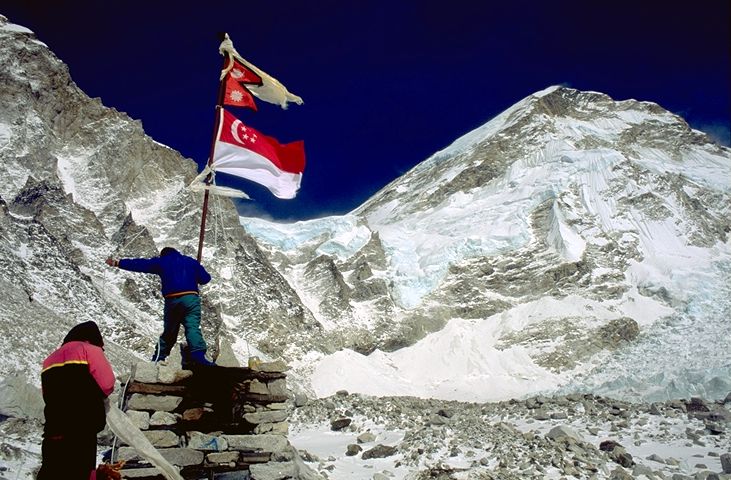
In 1993, when I revived the idea that a team from the flat, tropical city-state of Singapore could succeed at climbing Mt Everest, the idea itself was laughed at in many quarters. The Internet was just being embraced by Asia, and Singapore was abuzz with the culture of making money and material success. The highest building here is 280-metres above sea level, the highest peak, 163-metres. Not exactly ideal conditions for developing a team for Everest. Sure, we had a lot of technical rock-climbing experience, but only mud walls to sink our ice axe picks into. The right preparation involved a lot more equipment, leadership, team dynamics, endless fundraising, and then pulling off a number of expeditions to 6000m, 7000m and 8000m peaks. I’ll fast-forward the tale by nearly four years to when we had raised the funds, and had finally reached Everest.
The journey up to Everest involves a series of yo-yo like steps where you climb here to establish successively higher campsites and acclimatize to the altitude; and then descend to let your bodies build up more red blood cells. With greater oxygen-carrying ability, you climb up again, move equipment you placed earlier and press up higher and repeat the process. We had successfully placed and stocked our campsites, and with a decent window of good weather in mid May, began to make the four-day summit push. Leading four other members of my team on the summit push, I was climbing well until the persistent cough that affects many climbers became so virulent and violent, I cracked two ribs as a result. The “Khumbu Koff” is nicknamed, after the region where Everest is located, is pernicious condition brought about by the persistent super-dry and cold atmosphere at over 5000-metres. Lying in my tent with knives stabbing my side at every cough or sneeze; hopes of my own summit success faded away quickly.
I lay in a deep blue funk, feeling depressed and sorry for myself until the following morning when I asked myself, what I have later discovered to be one of the ultimate coaching questions:
“So Dave, what do you want now?”
I sat there for a while thinking until the answer I came up with was “ I want the team to succeed, even if I am unable to reach the top myself”. That immediately galvanized me into action. I was still the team leader of the 1st Singapore Mt Everest Expedition – and I could still contribute in so many ways. I recall being motivated in devising a way I could retreat down the mountain safely with my injury (a huge worry). I also swapped my far lighter alloy ice axe and crampons with Edwin’s heavier steel axe and crampons. Edwin, one of the youngest and least experienced in the team had been invited to accompany the summit team to Advanced base camp half way up. As it panned out, he took my place, and with my lighter gear, joined the rest of the summit team. That team did not succeed in reaching the top two days later owing to a lack of fixed rope to protect the trickiest parts of the route. They and 30 other climbers from other teams came within 150 vertical metres and a couple of hours to the summit- and turned back.
I then asked the team and myself a series of questions, each one exploratory and divergent; gathering as many views and opinions as possible. But they were mostly slanted towards exploring the strength of commitment to mount a 2nd attempt, as well as the resources we had
Four days later, on May 25th 1998, Edwin was one of the two climbers I picked for the 2nd and final attempt on the summit. He reached the top first; using my ice axe and crampons. I didn’t make the top that year, but my hardware did! So the question I used to coach myself is one I refer to now as a powerful ‘future-forwarding” question. The answer it demands can’t lie in the past. You can’t change the past, but you can influence the future. It’s a coaching question that can be transformational as it asks for some future action towards a goal.
In the workplace, the biggest resistance you get from leaders who should be, but don’t coach their teams is “I don’t have time”. But you definitely do have time to ask a few pointed questions – and that’s my point. A ‘coaching session’ isn’t a long sit down, formal session, although it can be. Leaders can coach others in more informal settings – over some coffee, in a drive through Mumbai traffic. It always starts with an open-ended problem or issue.
Start by getting a permissive frame e.g. “ I heard you…now permission to coach for a few minutes?” The next few minutes could be asking a series of exploratory question, setting up the options on the table so far, and then maybe unearthing more options the coachee hadn’t considered or given enough serious consideration. Sometimes, the answers to these questions themselves will help the coachee understand what they need to do. Very often the way ahead, or the decision to take action is held up not because of a lack of technical know-how (it rarely is, past a certain level of workplace competency), but more to do with mindsets about what people will think, or the risk-reward equation, or even the fear of failure. Your job then is to gradually but surely loosen some unproductive beliefs, to allow access to more solutions and, then encourage action.
My journey as speaker and coach hasn’t ended yet, nor has my love for the mountains and the climbs I have planned.
You never know what life has planned. But keep asking the right questions and you’ll start getting better quality answers.
David Lim is a motivational speaker, coach, and best known for leading the 1st Singapore Mt Everest Expedition. Since 1999, he has helped organizations motivate teams and grow leaders. Engage him with questions at contact@davidlimspeaks.com