Marshall Goldsmith’s 7 Lessons on Success
Marshall Goldsmith’s 7 Lessons for Success:
An evening with Marshall Goldsmith, or drinking from a firehose
He came across right away like Kentucky bourbon, with a smooth opening about his background, and then, a fiery kick later on as he got into the core of his ideas and future plans. Marshall was in Singapore recently, and through various sponsors of his visit and networks, a small group of us were privileged to interact and learn from him for an evening. If you’ve never spent an evening in a small group setting with one of the great business thinkers of our time, here’s what it was like for me.
Dr Marshall Goldsmith, leadership coach and consistently up there in Top 50 business thinker lists, New York Times best selling author, and executive coach to Fortune 500 CEOs was in Singapore and I had the rare opportunity to being in this group interacting with Goldsmith on business challenges. Goldsmith not only gave some wonderful anecdotes of his early years as an academic and leadership consultant, also covered the transition of the mindset shift from ‘coaching is for losers’ to ‘coaching is for winners’ over the years, and how to be successful in this business. There comes a point where the trust is so strong between the coach and person coached that that you can ‘call out’ that person if they did not do what they said they would do. Having coached thousands, Goldsmith always adopts a ‘Buddhist” approach by inviting coachees to take what works from their session and drop what doesn’t work. He also encouraged people to, when being coached, to stop resisting feedback.
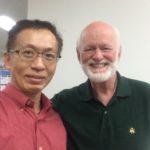
David Lim and Marshall Goldsmith
Here are some of his best points, delivered with honesty, assertiveness and humour:
1) Ask for Help – and one of the best things you can do is to cultivate a panel of ‘tangential experts’ to help you. They may not be experts in your exact field but experts in a related field. This can help you immensely in getting an expert perspective in an area that impacts your main field of work. In similar vein, and bluntness, he urged us to stop ‘pissing on each other’ and do more to help each other; building a virtuous cycle of giving ( having received benefits ourselves). Go so far as findng 10 mentors who can help you progress. Marshall’s next project in this area is giving away everything he knows to 15, yes FIFTEEN people. He’s hoping for a diverse group of people to benefit from this. His website says: “The only ‘fee’ for this mentoring is that the 15 Coaches who are selected have to promise to do the same thing for 15 other people when they get older. My hope is that this pay it forward project may ultimately benefit hundreds, or even thousands, of people.” Applications and details are here.
Marshall said about 15,000 have already applied for the 15 places. Good luck if you give it a shot.
2) To grow, you’ve got to get out of the “comfort trap”. To that end, this resonated with my belief that we should all do something every year that really scares us from a personal growth or professional development perspective. For me this year it was delivering my first ever series of one-day versions of the expanded keynote Lessons from Everest in Kathmandu and Muscat this year; a few years ago, it was training for climbing using methods very different from two decades of my experience, in order to climb a 6000-metre virgin peak in China.
3) On ‘directive coaching’ sometimes, you just have to tell your coachee to “drop that shit” referring to some attitude, or habit that’s simply unproductive. It’d be interesting to watch Marshall taking a whole load of excuses from a CEO sitting across him, and then replying with that riposte. It’s often as simple as that. Your arm hurts when you do that ?- STOP doing that!
 4) “Thank you, Marshall” – when you are really being coached well, or being coached by someone as experienced like Marshall, resist the siren call of the ego to pushback some essential feedback. Just accept it and say “thank you”. You’ll find a way later to extract the useful bits of the information given. In many ways, getting coached well requires both the coach and the coachee to put their egos aside. Marshall would often say to clients. “My job isn’t to make ME look good, it’s to make YOU look good, and do better”.
5) It’s all about action. Returning to check-in on the many people he has coached, he’s found that the ones making progress are those who actually took action. For many others, it was not that they were dysfunctional. Things happen. The ‘busy-ness’ of work can be overwhelming. Ultimately, the results you get from coaching depend on whether or not you complete the assignments given, and follow the feedback.
6) On success in the business of coaching/consulting/training: You’ve simply got to speak perfect English. That’s why so many of the world’ s best known, bestselling and successful consultants and ‘experts’ happen to be British, American or Indian. He emphasized that we should “write for the American market” – and that means writing clearly so that even a young teenager can understand what points are being made. No one’s impressed by your wordiness or ‘smarts’.
7) Keep pumping stuff onto The Wheel – the evening ended with Marshall sharing an idea for his next book. He’d just dreamt it up the previous night. What makes people like Richard Branson sit right on top of the tables in terms of followers, blog viewership and so on? Marshall’s premise, and yet to be researched and explored, is that we are in a wheel of life comprising our experiences, and information that come physically into our lives or, like now, digitally. A hundred years ago, this wheel spun very slowly, You probably didn’t know much of what was happening in the greater world except for the odd news sheet, travellers visiting your village, gossip or from official decrees. Now the wheel is spinning ever faster. To get noticed, and to influence others, you need to pump the wheel with information of value, or nuggets of data that excite and inform your audience. Because the wheel is spinning so fast, things you post are up there and gone within a day or less, like the newsfeed in a Linkedin profile. What’s the strategy of staying relevant by pumping more into the wheel? That’s what needs to be explored in this new book.
” Thank you Marshall.”
David Lim is Asia’s Summit Guide, and best known for leading the 1st Singapore Mt Everest Expedition. Since 1999, he has helped organizations grow leaders. To reach their summit. aConnect with him on Linkedin for continued access to his features-https://www.linkedin.com/in/everestmotivation